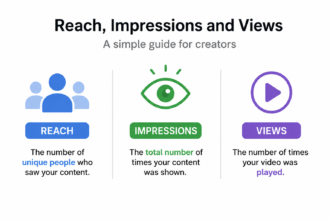





A YouTube video with fewer views can still beat a viral video. The reason is watch time. Watch time is the total minutes people actually spend watching a video but a view is different. YouTube counts a view once someone presses play for about 30 seconds, even if they leave right after.
YouTube cares about watch time more than anything else when it picks which videos to show people next.
How YouTube counts watch time
YouTube counts watch time in two ways: for one video, and for the whole channel. A channel’s total is not permanent. It only counts the last 12 months. Each day, the oldest day drops off and a new day gets added. TubeBuddy explains that a huge spike from over a year ago stops counting, no matter how big it was.
Here is a simple example: A video watched by 1,000 people for one minute each gets 1,000 minutes of watch time. Another video is watched by only 200 people, but for five minutes each. That is also 1,000 minutes. YouTube likes the second video more. Fewer people watched it, but they stayed longer, and that shows real interest.
Watch time is not the same as retention
People often mix these two up. Retention is how much of a video someone watches, shown as a percentage. Watch time is the total minutes watched, added up across everyone who watched.
A 20-minute video watched halfway by 5,000 people has low retention. But it still has a lot of total watch time. YouTube looks at both numbers.
Shorts work differently
YouTube Shorts do not count toward the 4,000-hour watch time goal at all. A Short can get millions of views and still add zero hours to that total. A channel can still get monetised through Shorts, but it needs 10 million Shorts views in 90 days instead.
Why YouTube cares so much about this
YouTube makes money from ads. The longer someone stays on the platform, the more ads YouTube can show them.



Backlinko found that videos with more watch time tend to rank higher in YouTube searches too. A video that keeps people watching, and then watching the next video, gets pushed to more people by the algorithm.
Kavya Karnatac, a creator from Mumbai who runs KK Create, talks about this exact idea. She says a great story means nothing if it is not packaged well. She still spends a lot of time on packaging, even now. Her rule is to hook the viewer in the first 15 seconds. Then add something new every 30 seconds after that. If nothing new happens, people leave. That is retention, in practice, before YouTube even measures it.
The same idea works differently on other apps
YouTube built its whole system around watch time. Other apps do not work the same way. On Instagram, the average Reel is watched for about three seconds. Instagram has even said shares (through DMs) matter more than watch time.
That is much faster than YouTube’s 30-second rule. LinkedIn shows watch time in stages instead: 25%, 50%, 75%, and 100% watched. Facebook counts a view after just three seconds. So a number that looks bad on one app can be totally fine on another. Each app rewards a different kind of attention.
What this means for getting paid in India
Watch time also decides who gets paid on YouTube. To join the YouTube Partner Programme, a channel needs 1,000 subscribers and 4,000 public watch hours in the past 12 months.
India has more than 450 million YouTube users, one of the biggest audiences in the world. But ad rates in India are lower than in the US or UK. So Indian creators usually need more views to hit the same watch-hour goal.
A new change creators should watch
YouTube’s watch-time system has not changed much since 2012. That might be about to shift. Google launched Ask YouTube in May 2026. It lets someone ask a question and get one short clip as the answer, instead of a full video to watch.
Right now, only Premium users in the US, aged 18 and over, can use it. There is no date yet for India. But if more people start getting quick clip answers instead of watching full videos, YouTube’s whole watch-time system could change with it. Google has not said whether a short clip counts the same as a full watch. For now, everything in this article still holds true, but it is worth watching.
FAQs
Is watch time more important than views?
Yes. YouTube relies on watch time more when deciding what to recommend. A video with less views but more total watch time often exceeds a video with more views.
How much is 3,000 watch hours in views?
It depends on the average watch duration. At a 5-minute average watch per view, 3,000 hours needs roughly 36,000 views. At a 10-minute average, it needs roughly 18,000 views. Shorter average watch times need far more views to hit the same hour total.
What is the difference between views and watch time?
A view counts once someone plays a video for about 30 seconds, no matter how long they stay after that. Watch time is the total minutes watched, added up across every viewer. A video can rack up high views but still have low watch time if people leave early.
Can a channel monetise with 500 subscribers and 3,000 watch hours?
Partially. That combination unlocks YouTube’s early access tier, which allows channel memberships, Super Chat and Super Thanks. Full ad revenue still needs 1,000 subscribers and 4,000 watch hours in the past 12 months.