





Your invoice is probably a Google Doc with your name, a rounded figure, and a bank account number. It goes to the campaign manager, who sends it to the accounts team where somebody who has never watched your content decides whether it clears. They are not judging your work, they are checking whether the paperwork is complete enough for the company to process it, and if something is missing, your invoice returns.
You are probably not even dealing with the brand directly. A marketer survey found that only about a third of brands run influencer marketing themselves, which means roughly two-thirds of the time you are being paid through an agency instead, and every company has its own billing cycle. A messy invoice gives that system another easy excuse to sit on your payment.
Check whether you even need to charge GST
You only have to register for GST once your yearly income from services crosses ₹20 lakh. Below that, you cannot charge GST and should not print a GST number anywhere on your invoice. Title the document Invoice rather than Tax Invoice, and skip the tax lines entirely.
What your invoice needs on it
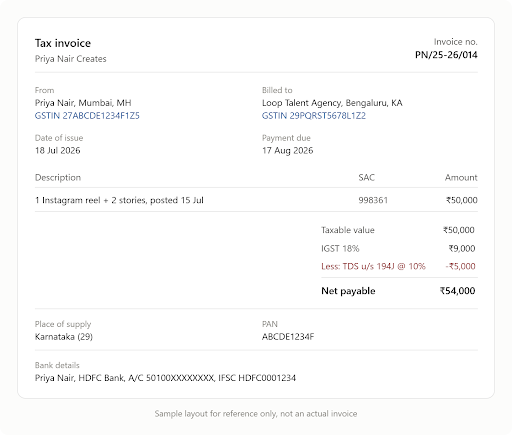
Your name, address and GST number. Use the name you are registered under with the tax department, not your channel name. The brand’s software checks this against the government portal, so a mismatch stops everything.
An invoice number. Keep it running in sequence, with no repeats and no gaps. If yours looks like a random file name, that alone is a common reason it gets sent back.
The date you issued it, and the date payment is due. Write the due date on the invoice itself. It is what you point to later if the money is late.
The client’s full name, address and GST number. The agency and the brand are two different companies, and billing the wrong one is why you end up waiting on money that was never in that company’s system to begin with.
What you actually delivered. List the deliverables and the date they went live, such as one Instagram reel and two stories posted on a given date, instead of writing the vague “content services”.



Your fee, with tax shown separately. Put the fee on one line and the tax on its own line below it. Folding tax into a single total is a common reason invoices get rejected.
Where the service counts as supplied. This follows the state in the client’s GST number rather than the address mentioned in the brief.
Your bank details and a signature. Account name, account number and IFSC, and make sure the account name matches the name you have raised the invoice in.
A few extra lines that make brands take you seriously
Add a usage clause naming the platforms, the time period, and where the brand can use your content. Along with this, a late payment line with a real number attached so it signals that you track your dates and expect others to.
How you send the invoice matters almost as much as what is on it. Rather than a Word or Excel file, send a PDF that gets processed. Copy the brand’s finance contact along with your deal manager (if any). And always put the campaign name or purchase order code on the invoice, because that is what lets it get matched to an approved budget automatically instead of sitting there while somebody works out which budget it belongs to.
Where to actually make one
Zoho Invoice, Refrens, Vyapar, Swipe, ClearTax, and CreatorKhata all generate invoices with the right fields already built in, and most are free at the volume you are billing at. Canva also makes the best-looking invoice and the weakest one, since it lays out a document without checking a single field on it.
FAQs
How do I create a GST invoice?
You can use a spreadsheet, a free template, or an invoicing tool like Zoho Invoice or Refrens, and make sure it carries the required fields.
- Add your registered name, address and GSTIN
- Give it a unique invoice number and the date
- Add the client’s legal name, address and GSTIN
- List what you delivered, with the SAC code for the service
- Show the taxable value, then the tax (CGST+SGST or IGST) on its own line
- Sign it, physically or digitally
How can I get a GST invoice?
You get a GST invoice by first registering for GST, which is what makes you eligible to issue one.
- Register on the GST portal at gst.gov.in once your yearly income from services crosses ₹20 lakh
- Submit your PAN, address proof and bank details, and complete Aadhaar verification
- Registration is usually approved within about a week
- Once you have a GSTIN, you can raise GST invoices yourself in any format
What are the rules for a GST invoice?
A valid GST invoice has to include:
- Invoice number and date
- Your name, address and GSTIN
- The client’s name, address and GSTIN, if they’re registered
- A description of what was delivered, with the SAC code
- Place of supply and delivery address
- Taxable value, with the tax rate and amount shown on their own line
- A signature
For services, the invoice has to be issued within 30 days of delivering the work.
What is a B2B invoice in GST?
A B2B invoice is one raised to a client who is also GST-registered, so their GSTIN appears on it, and they can claim the tax back as input tax credit. Most brand and agency deals fall into this category. A B2C invoice, by contrast, goes to someone without a GST number and gives them no tax credit, so the GSTIN field is what tells the two apart.