




For years, the creator economy in India has looked like a young person’s game. Viral reels, Gen Z creators, and trend-chasing content have dominated both headlines and brand budgets, and for the most part that picture still holds. As per Kofluence’s latest Creator Economy Report, close to 90% of creators in India are under the age of 35.
But underneath that youth-heavy surface, a second pattern is starting to show.
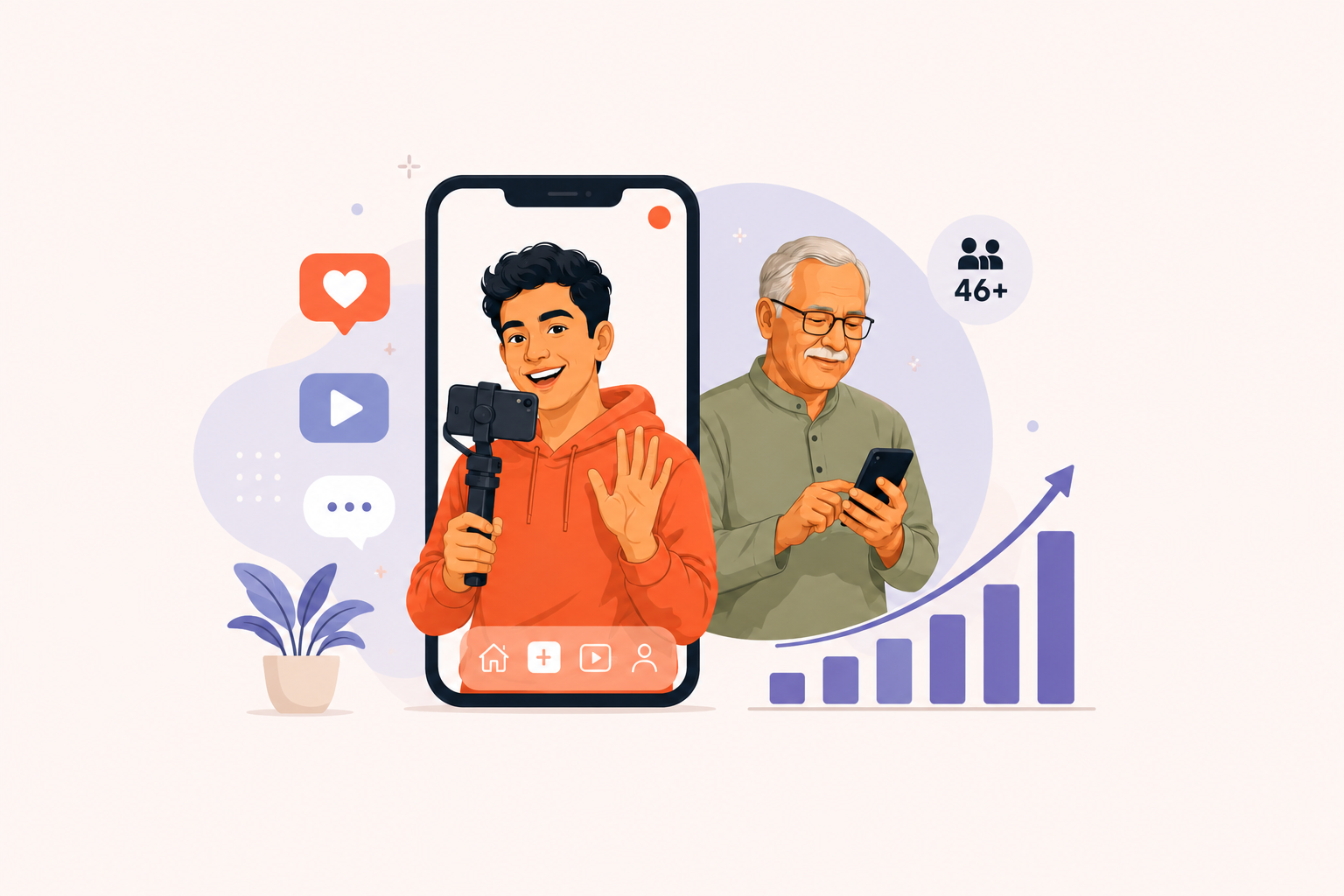
The report finds that creators in the 36 to 45 age bracket are growing on YouTube, largely on the back of long-form educational and financial content. Creators aged 46 and above, meanwhile, still make up only 2 to 3% of India’s creator ecosystem, despite the country having more than 160 million adults in that age group.
That gap doesn’t mean older creators are about to take over the industry. It means one of the most under-represented segments in India’s creator economy is also, by the numbers, one of its least contested opportunities.
The ecosystem is still built for the young
India’s creator economy grew fast over the last decade, riding cheap smartphones, social platforms and short videos. Most of its early breakout stars built their audiences in their twenties, which is a large part of why the industry still skews young today.
But the people who built those audiences are ageing along with everyone else. Several creators who defined YouTube’s early years in India are now in their late thirties and forties, and a newer wave of creators in finance, healthcare, education and business are often starting their content careers only after building a career elsewhere first.
That shift shows up most clearly on YouTube, where longer formats reward depth and subject knowledge in a way that a 30-second reel usually can’t.
As per the Kofluence report, the 36 to 45 age bracket is growing by roughly 10% on YouTube, driven mainly by educational and finance-focused content. Creators aged 46 and above still lag far behind. The obvious question sitting underneath that number: if India’s population is ageing, why isn’t its pool of creators ageing with it?



In some categories, experience is the product
Not every content category rewards the same thing. A comedy creator can succeed on timing. A fashion creator can succeed by catching a trend early. But in personal finance, healthcare, taxation, law or entrepreneurship, audiences are usually looking for something else entirely: proof that the person talking knows what they’re talking about.
That’s where years of professional experience become a genuine edge rather than a liability. A chartered accountant walking through a tax change, a doctor explaining a health risk, or a founder talking through a decade of decisions carries a kind of credibility that’s difficult to fake and even harder to build quickly.
For brands operating in these categories, that credibility can matter more than raw follower count, particularly in financial services, insurance, healthcare, real estate and premium travel, where the purchase decision is considered rather than impulsive.
Age hasn’t slowed some of India’s biggest creator businesses
A handful of India’s most recognisable creator-led businesses were built by people well past the age most brands associate with “influencers”.
Ankur Warikoo, the former CEO of Nearbuy and Groupon India who turned to content full-time after stepping down in 2019, is 45 and has built one of India’s largest personal brands around entrepreneurship, money and productivity, reaching an audience of students, early-career professionals and founders alike.
Sandeep Maheshwari, also 45, built ImagesBazaar into one of the world’s largest stock photography libraries before moving into motivational content. His YouTube channel now runs past 28 million subscribers, making him one of the most-watched Indian creators in any category, of any age.
Nisha Madhulika offers the sharpest version of this pattern. A former schoolteacher, she started her YouTube channel at 52 after her children left home, filming home-style vegetarian recipes from her kitchen in Noida. She’s now 66, runs a channel with over 15 million subscribers, and is widely reported as India’s highest-earning female YouTuber. She didn’t adjust her content to chase a younger internet. The internet came to her.
In healthcare, gastroenterologist Palaniappan Manickam, known online as Dr Pal, built a following of nearly 4 million subscribers on YouTube by mixing medical explainers with stand-up comedy, a format he calls MedCom. Globally, the pattern holds too: Marques Brownlee has spent well over a decade reviewing consumer technology and still shapes premium purchase decisions, while Martha Stewart has carried a decades-old media brand into the creator economy without losing her audience.
None of these creators built their following by fitting the industry’s image of what an influencer looks like. They built it because people kept coming back for information or judgement they trusted.
Older creators don’t automatically mean older audiences
There’s an assumption worth checking here: that a creator over 40 automatically pulls in an audience over 40. In practice, that’s often not true.

Warikoo’s videos are watched heavily by students and people early in their careers, looking for financial literacy and career direction rather than retirement advice. Dr. Pal’s healthcare content reaches plenty of younger viewers interested in gut health and nutrition, not just people managing age-related conditions. Even Nisha Madhulika’s audience skews toward first-time cooks and young families learning to cook at home, not toward people her own age. Brownlee’s tech reviews pull a similarly young crowd internationally.
A creator’s own age, in other words, doesn’t set the age of their audience. What draws an audience, at any age, is whether the creator has earned the right to be trusted on the subject.
The real gap sits further up the age scale
If the 36 to 45 bracket is already growing on YouTube, the more interesting whitespace sits just past it. As per Kofluence, creators aged 46 and above still make up only 2 to 3% of the ecosystem, a share nowhere close to their weight in India’s adult population.
That mismatch points to real room for growth, particularly in categories where professional depth counts for more than production value.
It also raises a genuine open question about where the next wave of creators comes from. Retired professionals, doctors, lawyers, chartered accountants, teachers and former executives sit on decades of exactly the kind of domain knowledge that categories like finance and healthcare reward. Whether more of them choose to bring that knowledge online, and whether India’s ageing audience starts actively seeking out creators closer to their own life stage, is still unwritten.
An industry that’s starting to mature
India’s creator economy isn’t about to stop being youth-led. Entertainment, lifestyle and trend content will keep belonging to younger creators for the foreseeable future.
But a second layer is forming alongside it. Long-form, expertise-driven content in finance, healthcare and business is rewarding depth over novelty, and several of India’s most commercially significant creators are already well outside the industry’s usual definition of “influencer”. They got there by building trust over years, not by chasing a trending sound.
As per Kofluence’s report, the segment best positioned to grow into that gap, creators aged 46 and above, remains the most under-represented age group in the entire ecosystem. What’s changing isn’t the age of India’s audience. It’s how long the industry has taken to notice.