



Brand deals in India have never been bigger. Budgets are up, rates are up, and the number of creators being approached for commercial work has grown faster than most brands anticipated. What has not changed is what happens after the content goes live.
According to Aditya Divecha, founder of PaydScore, a payment intelligence platform built for India’s creator economy, the average wait for payment clearance after delivery is 60 to 90 days. For a creator whose primary income is brand deals, 90 days is not a timeline but a problem.
View this post on Instagram
Fast growth, slow payments
According to a May 2025 BCG report on India’s creator economy, creators currently influence ₹29-33 lakh crore in consumer spend, generating ₹1,660-2,075 crore in ecosystem revenues annually. By 2030, BCG projects creator-influenced spending will cross ₹83 lakh crore, unlocking ₹8,300-10,375 crore in ecosystem revenues, that’s a 5x jump from where things stand today.
The numbers get cited often, usually to illustrate how fast the industry is growing. What they do not illustrate is how that money actually moves, or when.
According to Divecha, the standard payment structure for brand-creator deals in India runs on net-30 to net-90 terms which means a creator who posts a campaign in January may not see the money until April. For someone running a one-person operation with no fixed salary, that gap is the difference between a functional quarter and a difficult one.
The same BCG report found that only 8-10% of India’s 2-2.5 million creators effectively monetise their content.
The problem falls hardest on mid-tier creators, those running between 50K and 500K followers, large enough to be taken seriously by brands but not large enough to have a lawyer reviewing contracts or a manager making calls on their behalf. They are the ones most likely to absorb a delay quietly and move on.


Why they keep saying yes anyway
The obvious question is why creators continue working with brands that have a history of paying late, and Divecha’s answer is straightforward.
“Creators don’t refuse the work because they don’t know how the brand is paying in the first place,” he said. “That’s why we’re building PaydScore, so creators, freelancers, and agencies can see how brands pay before they sign.”
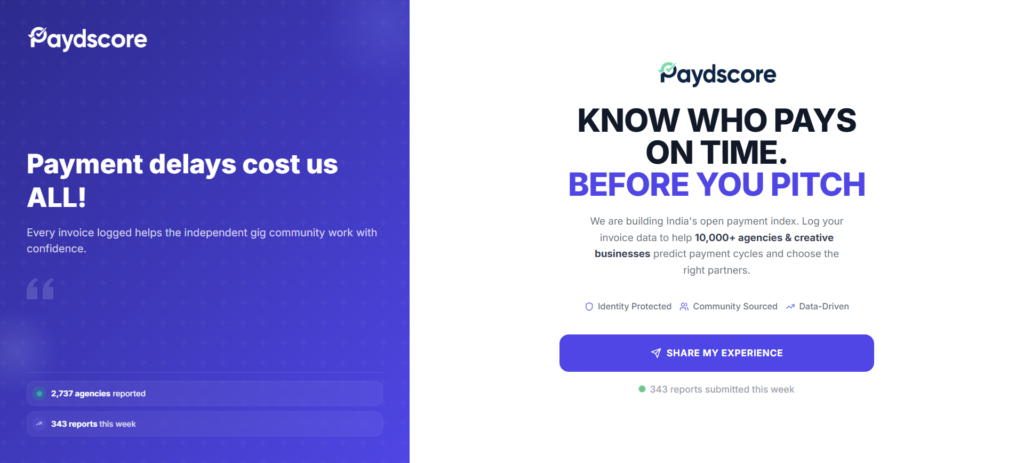
A creator receiving an inbound from a brand has no reliable way to know whether that brand pays in 30 days or 120. They can ask around informally, but that depends entirely on who they know and whether anyone in their network has worked with that brand before. For newer creators or those breaking into a new category, there is often nothing to go on at all.
Calling out a brand publicly is not a real option either. A creator who names a non-paying client on social media becomes the creator who names clients, which is the kind of reputation that gets you quietly removed from agency consideration lists before you even know you were on them. So most creators do not have much in their hands.
When delayed payment is a choice
Not every brand that pays late is struggling with cash flow, and Divecha does not pretend otherwise.
“I wouldn’t say every brand does it deliberately, because some brands do have a cash flow problem,” he said. “But at the same time, most take this as leverage because there is no accountability, or fear of losing work.”
The reason late payment persists in this industry is not complicated, it’s just there are no consequences for it. No industry body in India has meaningful authority over brand-creator contracts. ASCI’s regulatory framework, the most active one in this space, concerns itself entirely with what creators disclose publicly and not with whether they get paid for it.
How the platform works
Divecha describes PaydScore as “an infrastructure that lets you know how brands pay before you sign.” He said he started it because he had been a victim of delayed payments from his own clients.
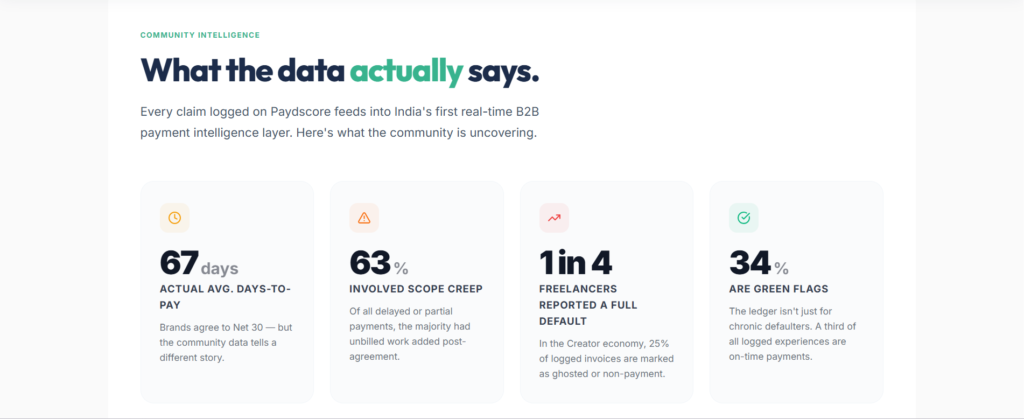
Creators, agency owners, and freelancers can log payment experiences against brands they have worked with, positive or negative. Each report requires proof of invoice and confirmation of a transactional relationship with the brand, which closes the most obvious door for fabricated entries. If a brand receives a report flagging poor payment behaviour, it gets a 14-day window to respond before the record is published.
“A brand can tell their good clients to put a good report about them,” Divecha acknowledged, “but apart from that, brands cannot gamify or suppress their own score.”
The platform also includes a smart deal memo, an e-contract that generates an invoice tracked within PaydScore until it is fulfilled. The intent is to move the tool from purely reactive territory into something that sits inside a deal from the point of signing.
What can a creator actually do with that information
When a creator checks a brand and finds a poor payment history, PaydScore does not prescribe a response.
“It’s then the creator’s choice whether they work with them or walk away,” Divecha said. “At PaydScore we’re not against brands. We want it to be on the ledger so it provides a fair chance for people to know before they sign a contract.”
In practice, the score changes the negotiating position more than it necessarily changes the decision. A creator who can point to documented payment defaults has a reasonable basis to ask for 50% upfront before the campaign goes live, a conversation that becomes significantly easier when the data exists and is not just a personal complaint.
The larger problem this exposes
Influencer marketing in India scaled fast enough that its operational infrastructure never caught up.
PaydScore does not solve the structural problem as it cannot accelerate payment timelines or give creators legal recourse. What it does is attach a cost to bad behaviour that did not exist before in a searchable, permanent record. A brand that has made a habit of paying 90 days late now carries that reputation into every deal it tries to make.
That creators had to build this themselves, with no platform, no industry body, and no regulator moving first, says more about the state of this industry than any market size projection does.